
Tower Rush guide: bonuses, demo and real money play
Three named storeys can change the course of a round in this Galaxsys crash title, and each is worth understanding before you spend anything. Below you will find what they do, where they sit in a full round, which figures are published and how free play works. Practical notes follow on exit methods, phone and tablet access, licensed paid play and keeping every session within limits you set yourself.
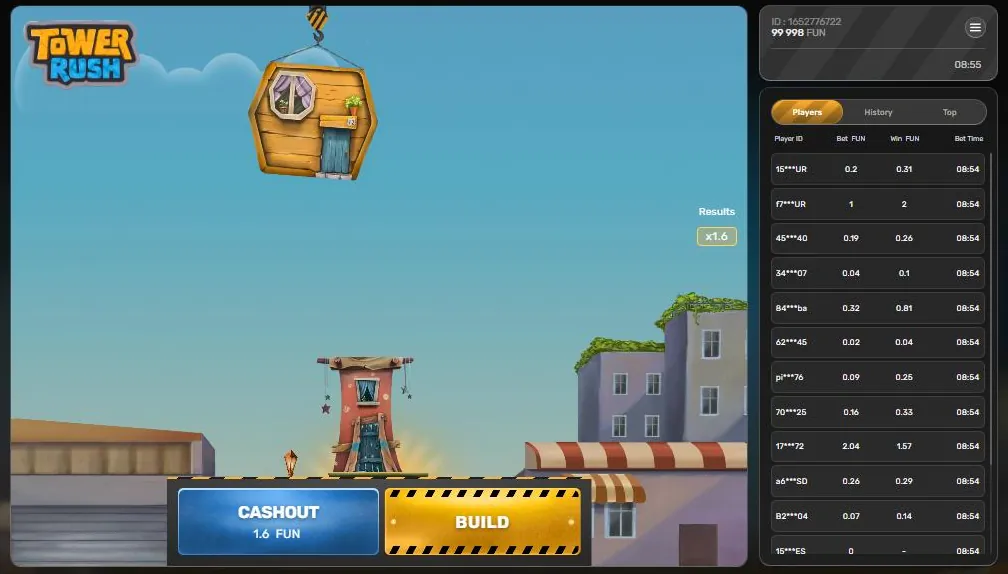
Tower Rush offers an exciting crash experience where players navigate the rising multiplier and cash out strategically. Test your skills in the demo version.
Summary
Tower Rush, développé par Galaxsys, est un jeu de crash captivant qui invite les joueurs à suivre un multiplicateur croissant et à encaisser judicieusement. Avec un RTP de 96,1–97,5 % et une volatilité moyenne-haute, il offre des gains maximums potentiels allant jusqu'à 100 fois votre mise. Profitez de mises allant de 0,1 à 100 sur diverses plateformes, y compris macOS, Android et iOS.
How a crash round works
- How to Navigate Tower Rush Gameplay — To get started, place your bet between zero point one and one hundred, then watch the multiplier increase as the game progresses.
- Tips for playing — Keep an eye on the rising multiplier and decide when to cash out before the crash occurs.
- How to cash out wisely — Balance your strategy between risk and reward as you approach higher multipliers.
Specifications
| Genre de jeu | Tower Rush |
|---|---|
| Équipe de développement | Galaxsys |
| Échelle de risque | Moyenne-Haute |
| Intervalle de mise | 0.1 — 100 |
| RTP | 96.1–97.5% |
| Récompenses maximales | 100x |
| Date de sortie | June 2026 |
| Genre | Variété de jeu crash |
Any given round of Tower Rush has a chance of being interrupted by something out of the ordinary, and that something usually comes in the shape of three named floors. Tower Rush itself, an instant crash-type title by Galaxsys, rests on an idea anyone grasps almost at once: storeys get stacked, the payout figure climbs, and you pick your moment to walk away.
Those three named floors stop the idea from going stale. Each of them, Frozen Floor first, then Temple Floor, then Triple Build, breaks into the usual climb differently, which means a round that seemed perfectly routine can change character halfway up.
So we open with them instead of with the basics. Most introductions begin at ground level and work upward. Here the order is reversed on purpose, since knowing what each special storey does makes the remaining mechanics much quicker to absorb.
Lower on this page come the round broken into steps, your two exit options, the figures Galaxsys publishes, free play, handheld devices, licensed real-money access and some plain advice on limits. Jump around freely.
Bonus floors in Tower Rush
Picture the trio as relatives who share one trait: not one of them is promised in a particular round, and none rewrites the central bargain. Each extra storey pushes the multiplier up. Each extra storey also makes a collapse on the next placement more likely. That tension survives whatever turns up.
What a special storey alters is the feel of the round. An ordinary one just adds a little to the multiplier. A named one departs from that routine, either by shielding money you have already built up or by shifting how the number develops afterwards.
A quick roll call:
Frozen Floor guards what you have reached at its height.
Temple Floor carries a multiplier behaviour peculiar to it.
Triple Build does the same, in a manner distinct from Temple Floor.
You will notice we attach no values to any of them. Effects can differ from one installed version to the next, and the trustworthy reference is always the rules panel inside the copy of Tower Rush you have loaded. Numbers quoted on forums or in videos deserve a raised eyebrow unless they match those rules.
Frozen Floor
Among the trio, Frozen Floor needs the least explanation, and it tends to be the favourite. Land on it and the winnings accumulated at that height are secured.
Picture a catch fitted partway up the structure. Normally, every bit of value gathered during a round stays exposed until you collect, and a fall takes all of it together with your stake. Frozen Floor carves out the sum reached at its level, so that portion no longer hangs on whatever gets placed next.
Being exact about its limits matters just as much. Your tower does not become indestructible, and the multiplier gets no boost from the frozen storey alone. Anything you might add higher up stays every bit as vulnerable as before.
That leaves you with a genuine choice once it appears. Carry on, with part of your result now safe, or bank what the round currently offers. Neither option is automatically correct.
Players often say this storey changes their mood more than any other. That reaction is natural. Still, it should never override the spending ceiling you settled on before logging in. Having a sum secured is pleasant; it is not a reason to raise your next stake.
Temple Floor
Temple Floor sits in the pair of special storeys with distinctive multiplier behaviour. Instead of adding a small step the way a plain floor does, it modifies how the figure travels after it lands.
We keep the description general deliberately. Galaxsys ships the game in several versions, and the precise effect of Temple Floor belongs in the rulebook bundled with whichever one you open, not on an overview like this. A site naming a fixed value for it without citing those rules should make you wary.
Here is the useful part: when Temple Floor shows up, the round has left its standard track. The danger of the following placement toppling everything has not gone anywhere. Your call about continuing deserves exactly the same care it needed a moment earlier.
Demo mode is where this floor makes sense fastest. Spend a little time with virtual credits, wait until a Temple Floor arrives, and keep your eyes on the multiplier immediately afterwards. A few minutes of observation beats any paragraph we could write.
Triple Build
Triple Build is the other floor that brings a multiplier behaviour all its own. The name suggests that more than one storey is involved, but guessing at mechanics would be pointless when the rules spell them out properly.
What we can confirm is short. Triple Build is one of the special storeys, the game rather than the player decides whether it appears, and once it does, the multiplier moves differently from there on. For anything more detailed, check the rules of your version.
A practical point outweighs those details. Anyone using auto cash-out should remember that the target they typed in still governs when the round closes for them. Triple Build does not cancel or move that setting, so pick the target with that in mind.
As with Temple Floor, the sensible course is to meet it before risking money on it. Running into a Triple Build for the first time with only virtual credits at stake feels far less tense than discovering it mid-wager.
How the floors fit into a Tower Rush round
Special storeys only make sense inside the rhythm of a whole round. Here is that rhythm, start to finish.
Choose a stake. Tower Rush accepts a single-round wager with the lowest permitted amount being €0.10 and the highest being €100, although your casino's settings determine which part of that range is available to you. Choose whether to automate your exit. For an automatic exit, enter your chosen multiplier before the play begins. To judge each moment personally, skip this. The round starts on an empty plot. No storeys yet, no movement in the multiplier. Storeys begin to rise. Each placement increases the multiplier, and every placement also slightly raises the likelihood of the next one triggering a collapse. Spot any named floor. Frozen Floor secures what you have reached at its height; the other two reshape how the multiplier behaves from that point. Collect, either manually or through your preset target. Your balance increases by that stake, scaled up by whichever multiplier was active when you left, nothing more and nothing less. Should the structure collapse first, whatever you wagered there is forfeited, and a fresh empty plot awaits.
A worked example makes the maths concrete. Say you put in €10 and collect at x2.25: the return is €22.50. That x2.25 is purely a figure chosen for arithmetic, not a value belonging to any floor, and nothing guarantees a round will ever reach there.
Observe where the special storeys are located: in the middle, as events unfold within the climb. None replaces the decision made in step six.
Cash-out options
Exiting a Tower Rush round at the right moment is truly the only skill this game demands, and there are two ways to achieve this. Neither wins in every circumstance. They suit different temperaments, and many players switch between them.
Manual
Going manual keeps the timing in your control. While storeys keep rising, you may stop whenever you wish as long as nothing has collapsed, taking home the stake multiplied by the live multiplier.
Its strength lies in flexibility. If Frozen Floor has just protected part of your results, or Temple Floor has altered the multiplier's path, you can assess that on the spot.
Its weakness is pace. Rounds progress quickly, and hesitation costs money; a moment's doubt can separate a payout from a lost stake. If you find yourself freezing or clicking impulsively, consider the other route.
Automatic
Auto cash-out relies on a target multiplier set in advance. Once a round reaches that figure, Tower Rush collects for you automatically, so reflexes become irrelevant.
This cools each round down. The decision is made calmly, before anything starts moving, and the target remains fixed regardless of which special storey appears.
The downside is losing the ability to react. If the structure remains standing long after your target, you were already out. If it falls short of your target, the stake disappears just as it would with manual play.
About our Tower Rush page
What we aim for here is a clear explanation of the game, nothing more ornate than that. The focus remains on how a round unfolds, what the named storeys do, what the published figures indicate, and how to keep play within sensible limits.
To clarify roles: Galaxsys develops the game, while each casino that hosts it chooses settings such as its RTP version and its stake range. We present those facts as they are and direct players to the in-game rules whenever a detail varies by version.
You can also launch the free demo from this page, using virtual credits. It is the same game, available so you can observe the floors in action before making any decisions.
Intentionally missing from these paragraphs: any promise of profit, any system presented as a way to outpace a collapse, and any figures we cannot substantiate.
The studio behind the game
Tower Rush is developed by Galaxsys, the developer credited with it. Launched in 2026, it takes the crash format and wraps it around an image almost anyone can understand, a building rising floor by floor.
Galaxsys provides the title to online casinos, and those operators decide how it reaches players. That explains why some details, such as the RTP version and stake limits, vary between casinos while the core game remains the same.
We mention Galaxsys by name because credit should go to those who did the work. This page is not operated by the studio; it simply presents the game and the facts released about it.
Key numbers in Tower Rush
Several figures merit attention before you commit funds. A couple are ranges released by the studio; others only become apparent once you open the rules of a specific version.
RTP: published versions return between 96.1% (lowest) and 97.5% (highest). Rather than a single number, the studio provides a range, as the return depends on which version an operator has made live. Your exact figure is listed among the rules of the version you load. Keep in mind that RTP describes an average built over large numbers of rounds and says nothing about any single session. Stakes: a minimum of €0.10 and a maximum of €100 per round. That is the full range the game can accommodate, yet every casino sets its own limits within it, so what you see might be tighter. Volatility: noted in each version's own rules. We do not label it here, as those rules are the reliable reference. Maximum multiplier: likewise found in the rules. No figure from us; check the rules of your version. Maximum win: also outlined in those rules, and worth reading before any real-money play.
Two habits turn these figures into something actionable. Before placing your first wager at any unfamiliar casino, read the rules and note the RTP displayed. Then keep the stake range in mind while setting a budget, ensuring no single round can cost more than you are comfortable losing.
Free demo of Tower Rush
The Tower Rush demo exchanges money for virtual credits. Many casino sites offer it, and our page hosts it as well.
For a game that hinges on timing, starting without money is the obvious move. You see how fast a tower climbs, how often it topples earlier than you hoped, and what each special storey looks like when it arrives, with no money involved.
It also suits a side-by-side trial of both exit methods. Play several rounds manually, switch to a preset target, and notice which keeps you steadier.
One caution. Virtual credits make losses feel lighter than they are. A big multiplier in demo mode predicts nothing about a paid round, since every outcome is random. Use free play for learning the rules, never for forecasting.
Mobile play
Tower Rush runs inside a mobile browser on a phone or tablet, and on desktop machines too. Nothing needs downloading or installing.
That fact doubles as a safety rule. Because no download is required, any app or file presenting itself as the game, or promising better odds in it, should be treated with suspicion.
On a small screen, a dependable connection counts for a lot, given how quickly rounds move; losing signal mid-climb is maddening. When playing for money away from home, a preset auto target is a reasonable safeguard.
Where Tower Rush is played for real money
Paid Tower Rush rounds happen exclusively where a casino is properly licensed and carries Galaxsys games in its lobby, and exclusively for adults aged 18 or above.
Before registering anywhere, confirm the operator holds a valid licence and welcomes customers living where you do. Check the stake limits it applies, as they may cover only part of the full stake span.
The usual sequence is straightforward: sign up, complete the identity checks, make a deposit, then locate Tower Rush in the lobby's instant or crash category.
If a bonus is on offer, read its terms closely. Operators commonly specify how much each game counts towards wagering, which games are barred from it, plus a maximum bet allowed while the bonus runs. Such conditions are the casino's, not Galaxsys's.
Steer clear of anything marketed as a predictor, signal group or bot for this game. With every round random, no tool can know when the next collapse is coming.
Responsible gaming
Quick games such as Tower Rush call for firm limits. Its rounds last only moments, and moments pile up into long sessions without much warning.
Before starting, fix a budget and a clock limit, treating both as non-negotiable. Know which loss ends the session, and stop there rather than trying to recover it. Chasing losses is the most familiar route from an enjoyable evening to an expensive one.
Step away regularly, including when things are going well. A short pause from the screen helps you judge honestly whether you still want to continue.
Licensed casinos generally provide deposit caps and session timers, and many add cooling-off periods or self-exclusion. These tools exist precisely for fast formats like this one, so make use of them.
Each round is also completely separate from the last. Results are random, and nothing in earlier rounds hints at when the next fall will happen.
Should gambling stop being fun, or start feeling like a way to escape something, a professional help organisation is worth contacting without delay. Reaching out early is much easier than waiting.
Honest notes on Tower Rush
Some things are best said bluntly. The return you get rests on the version an operator installed, so the published span is not a guarantee of any single figure. And a tower that falls before you collect costs you the money staked on that round.
Top payout and volatility are both defined in each version's rules, which is where to look for them. No method, system or gadget can guarantee a win, however confidently it is sold. Tower Rush is a game of chance with an appealing visual hook, and it is most enjoyable treated that way.
Core Gameplay Features
Frozen Floor — The Frozen Floor secures your current winnings at that height, protecting your accumulated cash.
Temple Floor — The Temple Floor modifies the way the multiplier behaves, which can influence your final payout.
Triple Build — The Triple Build adds an additional layer of complexity to the multiplier calculations, enhancing gameplay.
Game Comparison
| Genre de jeu | Équipe de développement | RTP | Récompenses maximales | Échelle de risque |
|---|---|---|---|---|
| Tower Rush | Galaxsys | 96.1–97.5% | 100x | Moyenne-Haute |
| Spaceman | Pragmatic Play | 96.5% | 5,000x | Moyenne-Haute |
| JetX | SmartSoft Gaming | 97% | Ajustable | Intermédiaire |
| Rocketon | Galaxsys | 96.5% | 5,000x | Intermédiaire |
Pros and Cons
- The engaging mechanics of varied bonus floors keep the gameplay interesting and unpredictable.
- The game's medium to high volatility offers a thrilling experience for risk-takers.
- Players can enjoy betting flexibility with a range starting from zero point one to one hundred.
- The RTP of 96.1-97.5 percent suggests good long-term returns for players.
- The risk of crashing can make it stressful at higher multipliers, especially for cautious players.
- Newcomers might find the gameplay mechanics tricky to grasp initially.
- Lack of complex features may disappoint players seeking a rich gaming experience.
Frequently Asked Questions
1. Deux étages spéciaux peuvent-ils apparaître dans un même tour ?
Des niveaux spéciaux peuvent apparaître pendant un tour, et les conditions exactes qui les régissent sont définies par les règles de votre version. Si les combinaisons vous intéressent, lisez d'abord cette section au lieu de vous fier aux rumeurs.
2. L'Étage Gelé protège-t-il la mise entière ?
Sa protection couvre les gains atteints à sa propre hauteur, et c'est tout. Tout ce que vous espérez ajouter au-dessus est à risque si vous continuez à grimper.
3. Y a-t-il des étages spéciaux dans la démo aussi ?
Le mode démo fonctionne avec le même jeu, simplement financé par des crédits virtuels au lieu d'argent. Cela en fait un cadre calme pour rencontrer chaque étage avant que quoi que ce soit de réel soit en jeu.
4. Le retrait automatique peut-il se déclencher après un Double Build ?
Le cash-out automatique se déclenche à l'objectif que vous avez saisi. Un niveau spécial apparaissant plus tôt dans le tour laisse cet objectif intact, alors choisissez-le soigneusement avant qu'un nouveau tour ne commence.
5. Le RTP est-il le même sur chaque site ?
Pas nécessairement. Galaxsys publie une plage, et chaque opérateur installe une version particulière à l'intérieur. Deux casinos peuvent donc proposer le même titre avec des pourcentages de retour différents, il est donc utile de comparer leurs panneaux de règles si vous avez des comptes dans les deux.
6. Quel est l'intervalle de mise que Tower Rush accepte ?
Par tour, Tower Rush gère des montants d'au moins €0,10 et d'au plus €100. Les opérateurs peuvent restreindre cette fenêtre par leur propre configuration, donc les limites d'un casino peuvent sembler différentes ailleurs.
Prêt à tenter votre chance avec Tower Rush ?
Jouez à une démo maintenantPlay responsibly. This title is intended for players over eighteen. Please ensure you are familiar with your regional gambling regulations.